You walk down a street, catch the smell of bread fresh out of the oven, and suddenly you’re standing in a kitchen from your childhood. We’ve all been there. So why is it smell, more than a photo or a song, that does this best?

Smell’s Shortcut
Information from the eyes, ears or skin passes through the thalamus, a kind of relay station, before it reaches the parts of the brain involved in emotion and memory. Smell skips that stop and goes straight to regions closely tied to emotion and memory. That shortcut is one reason smells can stir such strong feelings and memories.
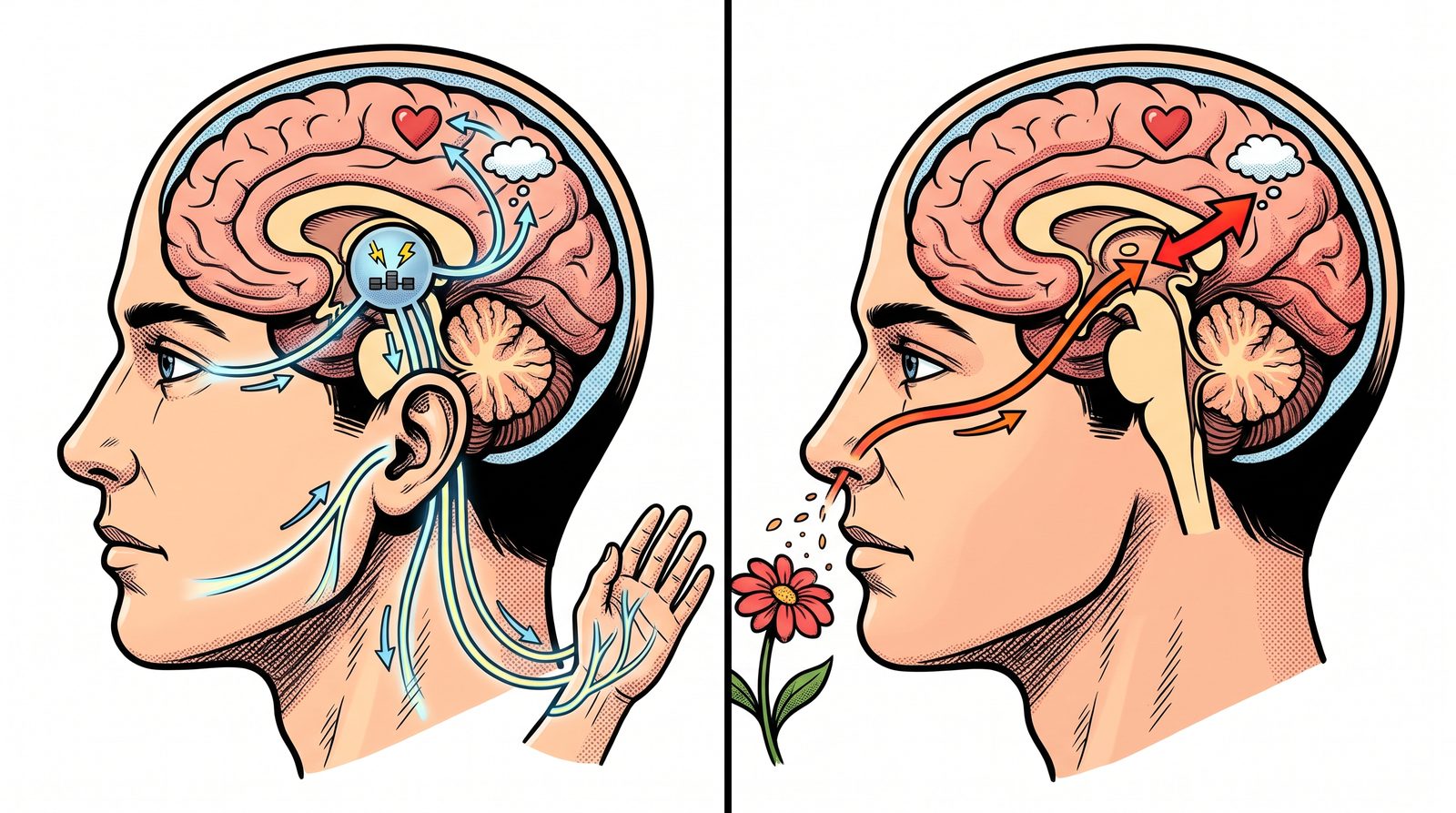
It’s also why marketers love scent. Hotel lobbies, shops, even the “new car smell” of some brands use carefully chosen fragrances. But measuring what a smell actually makes people feel is not easy. The answer to “did you like this smell?” is often only a small part of the experience.
Our Journey
Since 2022, our lab has run a series of studies on smell and EEG. With each one, the questions grew a little:
- Can we tell from EEG that a smell was presented? In our first studies, we tried to separate moments with and without an odour from brain signals alone. We saw this as a first step towards neuromarketing applications (SIU 2022, TIPTEKNO 2022).
- Which features capture that difference best? Next, we compared features drawn from different sides of the signal, such as time, frequency and complexity, and tried classic machine learning side by side with deep learning (TIPTEKNO 2024, Electrica 2024).
- What does a smell make us feel? In our latest studies we went a step further and tried to classify emotional responses to several different odours. One way was to turn EEG into a colourful heat map of the head seen from above, and analyse it with the convolutional neural networks we described in our CNN post (TIPTEKNO 2025).
In other words, we moved from “is there a smell?” towards “how does this smell feel?”.
Why Does It Matter?
Smell shows up everywhere, from product design to the experience of a space, and even in health, where tracking loss of smell matters. Being able to measure the emotional response to a smell, independently of what people say, gives all of these fields a new tool.
Burak Akbuğday, Sude Pehlivan Akbuğday, Dr. Faezeh Yeganli, Dr. Rıza Sadıkzade and Prof. Dr. Aydın Akan worked together on these studies. You’ll find the full list on our conferences page.
References
- The olfactory system as the gateway to the neural correlates of consciousness (2014). Frontiers in Psychology, 4, 1011. DOI: 10.3389/fpsyg.2013.01011
- Pehlivan, S., Akbuğday, B., Akan, A., Sadıkzade, R. (2022). Detection of Olfactory Stimulus from EEG Signals for Neuromarketing Applications. IEEE SIU. DOI: 10.1109/siu55565.2022.9864841
- Akbuğday, B., Akan, A., Pehlivan, S., Sadıkzade, R. (2022). An Assessment of Linear and Nonlinear Features for Detecting Olfactory Stimulus in EEG. IEEE TIPTEKNO. DOI: 10.1109/tiptekno56568.2022.9960190
- Pehlivan Akbuğday, S., Akbuğday, B., Yeganli, F., Akan, A., Sadıkzade, R. (2024). Decoding Olfactory EEG Signals Using Multi-Domain Features and Machine Learning. IEEE TIPTEKNO. DOI: 10.1109/tiptekno63488.2024.10755366
- Akbuğday, B., Pehlivan Akbuğday, S., Sadıkzade, R., Akan, A., Unal, S. (2024). Detection of Olfactory Stimulus in Electroencephalogram Signals Using Machine and Deep Learning Methods. Electrica. DOI: 10.5152/electrica.2024.23111
- Bozbas, O. A., Akbuğday, B., Akan, A., Pehlivan Akbuğday, S. (2025). Classification of Emotions Under Multiple Olfactory Stimuli Using EEG Signals and Machine Learning. IEEE TIPTEKNO. DOI: 10.1109/tiptekno68206.2025.11270194
- Yeganli, F., Akan, A., Sadıkzade, R. (2025). Olfactory Emotion Recognition Using EEG Spectral Topographic Heatmaps and CNNs. IEEE TIPTEKNO. DOI: 10.1109/tiptekno68206.2025.11270101