Think of a glass of smoothie. When you taste it, you get a single flavour. But inside there are strawberries, blueberries, banana and milk in certain proportions. The Fourier transform is the tool that works out this recipe for a signal.

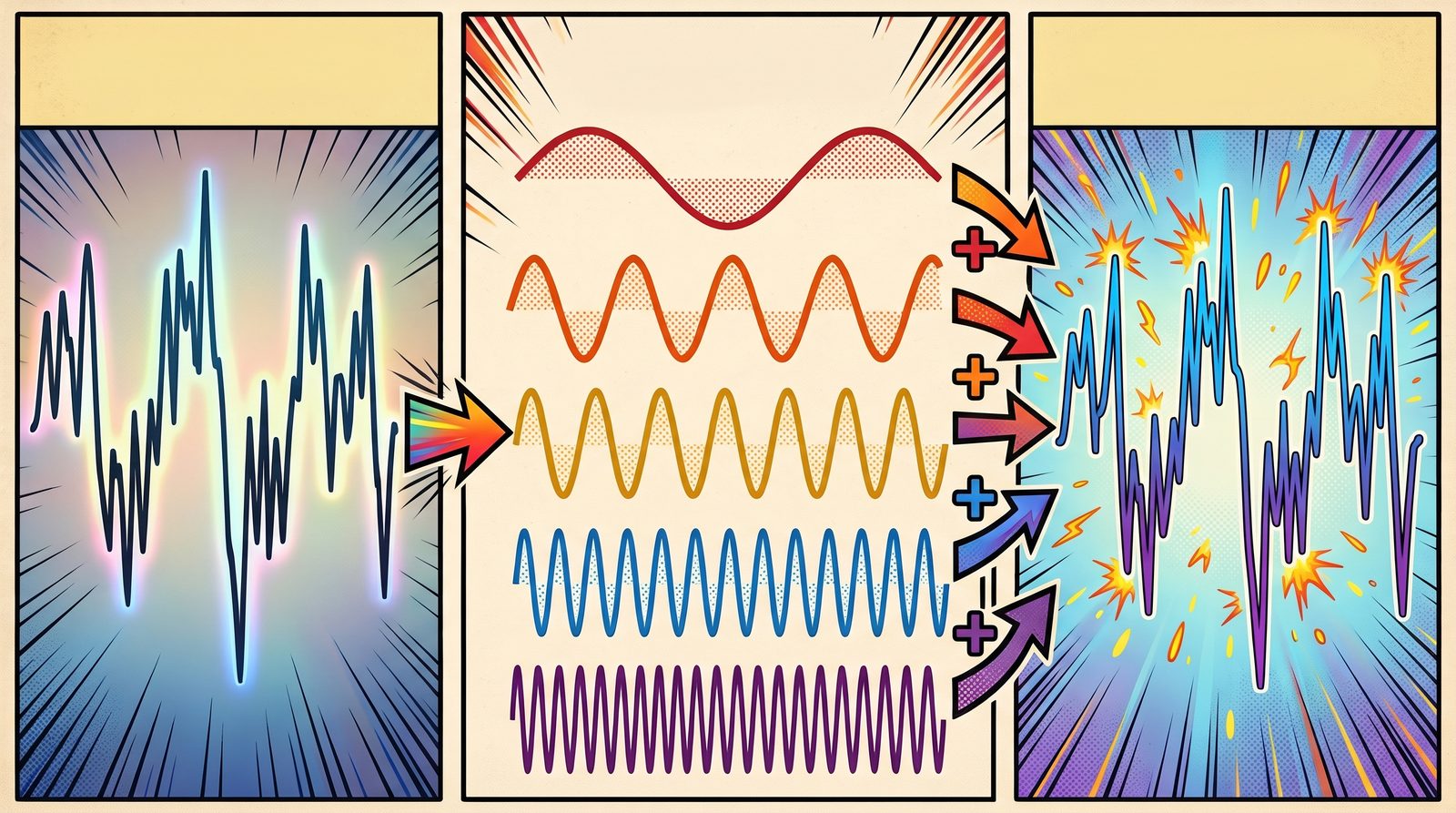
Fourier’s idea was this: however complicated it looks, every signal can be written as a sum of simple waves oscillating at different speeds, that is, sine waves. The transform tells us how much of each speed, each frequency, there is. This recipe is called the spectrum.
The key point: the Fourier transform doesn’t change the signal, it just describes it in another language. If you know the recipe, you can make the smoothie again. If you know the spectrum, you can get the signal back exactly.
Why Is It Everywhere?
When we say “alpha power went up” in EEG, we are actually looking at the spectrum: the share of the 8–13 Hz ingredient in the recipe has grown. Many jobs, such as removing noise, separating rhythms or compressing a signal, become much easier once the signal is translated into this language.
What made it practical was the fast Fourier transform (FFT). Computing the recipe of a 1024-sample signal the straightforward way takes about a million operations. The algorithm Cooley and Tukey published in 1965 does the same job in roughly ten thousand. Today it runs everywhere, from the music app on your phone to EEG software.
If you’d like to see the Fourier transform in more detail alongside EEG features, have a look at the spectral features post.
References
- Akan, A., Chaparro, L. F. (2024). Frequency analysis: the Fourier transform. Signals and Systems Using MATLAB, Elsevier. doi:10.1016/b978-0-44-315709-7.00015-x
- Cooley, J. W., Tukey, J. W. (1965). An algorithm for the machine calculation of complex Fourier series. Mathematics of Computation, 19(90), 297–301. doi:10.1090/S0025-5718-1965-0178586-1