Izmir University of Economics
Computational Neuroscience Lab
We measure and model the brain's electrical language to understand emotions and decisions.
All research areasAt the Department of Electrical and Electronics Engineering at Izmir University of Economics, we conduct research on emotion estimation and neuromarketing using physiological measurements. We use our lab’s recording systems to design experiments, collect data and analyze the results.
Our Active Research
The main topics our lab works on.
Our work gathers around one question: how does subjective experience leave a trace in measurable signals? In every project we run the experimental design, recording and analysis ourselves.
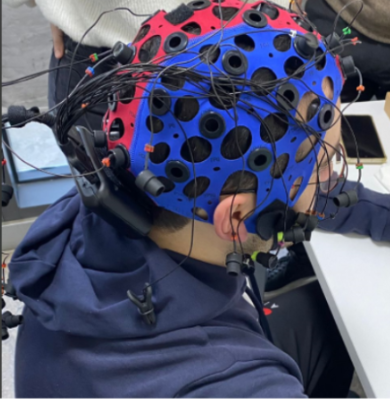
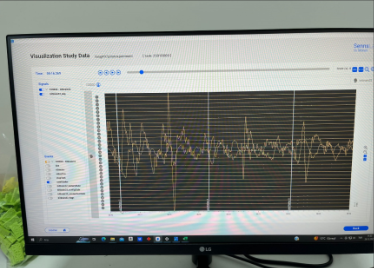
- Emotion, taste and preference We study how a product’s label changes its taste, and how the positive or negative emotional response during tasting can be told apart from EEG.
- Brand trust and decision-making We study what happens in the brain at the moment we trust a brand by looking at how EEG patterns cluster on their own, without imposing labels.
- Music and the brain We study how the emotion perceived in Turkish makam music and the emotion the listener actually feels are reflected in EEG and skin conductance.
- fNIRS with embedded AI We are building a wearable, whole-head fNIRS system that runs AI on the device itself.
- Multimodal biosignals We use EEG and skin conductance together to measure consumers’ emotional response to product mascots, and study which dimension of emotion each signal carries.
People
The researchers and students working in our lab.
Lab Leadership
Prof. Dr. Aydın Akan
Lab Lead His research focuses on time–frequency analysis of nonstationary signals and its applications in communications and biomedical engineering. akan.aydin@ieu.edu.trFull biography
Aydın Akan was born in Bursa in January 1967 and completed his primary and secondary education there. He studied electronic engineering at Uludağ University from 1984 to 1988. He began his master’s studies in electronics and communications at Istanbul Technical University in 1988 and completed the program in February 1991. His master’s thesis examined real-time adaptive noise cancellation for biological signals.
He joined Istanbul University in 1988 and was appointed a research assistant in the Electronics Division of the Department of Electronics Engineering in 1990. In March 1992, he began doctoral studies in signal processing at the University of Pittsburgh. He completed his doctorate on time–frequency analysis with Gabor expansions in April 1996 and returned to Türkiye. In December 1996, he was appointed assistant professor in the Electronics Division at Istanbul University. He became head of the division in April 1997 and deputy head of the department in February 1999. He earned the title of associate professor in signal processing in November 2000. Istanbul University appointed him associate professor in the Telecommunications Division of the Department of Electrical and Electronics Engineering on 2 May 2001 and professor on 31 October 2006.
In 2004, with a fellowship from TÜBİTAK, he worked as a visiting researcher and faculty member at the University of Pittsburgh. In February 2006, he was appointed founding coordinator of the Biomedical and Clinical Engineering Unit at Istanbul University Hospitals, a role he held until 2017. On 20 March 2017, he was appointed professor in the Department of Biomedical Engineering at İzmir Kâtip Çelebi University. He served as dean of the Faculty of Engineering and Architecture from May 2017 to October 2018. His roles at the university through 31 January 2020 included department chair, Scientific Research Projects coordinator, and director of the Biomedical Testing and Calibration Application and Research Center. On 1 February 2020, he was appointed professor in the Department of Electrical and Electronics Engineering at Izmir University of Economics.
Professor Akan’s research focuses on time–frequency analysis of nonstationary signals and its applications in communications and biomedical engineering. He has led and contributed to numerous projects supported by TÜBİTAK and university research programs. His work has appeared in books, journal articles, book chapters, and conference proceedings in Türkiye and internationally. He serves on journal review boards and on advisory, executive, organizing, technical program, and review committees for scientific conferences. He is an IEEE Senior Member affiliated with the Signal Processing and Engineering in Medicine and Biology societies. He is also a member of the EURASIP Technical Area Committee on Biomedical Signal and Image Analytics and serves on the editorial board of Elsevier’s Digital Signal Processing journal.
Publications in the lab (90)
- 2026 Investigation of the Effect of Product Mascot Gender on Consumer Emotions Using EEG Signals Medical Technologies Congress (TIPTEKNO)
- 2026 Deep Model Families for EEG-Based Multi-Class Dementia Classification International Journal of Neural Systems · DOI
- 2026 Analysis of Human Emotions for Different Taste Stimuli Using EEG Signals International Conference on Control, Decision and Information Technologies (CoDIT) · DOI
- 2026 Investigating the Effect of Sustainable Product Packaging on Consumer Behavior Using EEG Signals International Conference on Control, Decision and Information Technologies (CoDIT) · DOI
- 2025 Analysis of Dementia EEG Signals Using Empirical Mode Decomposition Variants and Deep Learning Medical Technologies Congress (TIPTEKNO) · DOI
- 2025 Classification of Emotions Under Multiple Olfactory Stimuli Using EEG Signals and Machine Learning Medical Technologies Congress (TIPTEKNO) · DOI
- 2025 Design of a Smart Infusion Pump with Decision Support TIPTEKNO 2025 - Medical Technologies Congress, Proceedings -- 2025 Medical Technologies Congress, TIPTEKNO 2025 -- 26 October 2025 through 28 October 2025 -- Gazi Magusa -- 217812 · DOI
- 2025 Olfactory Emotion Recognition Using EEG Spectral Topographic Heatmaps and CNNs Medical Technologies Congress (TIPTEKNO) · DOI
- 2025 Detection of Alzheimer’s Disease by Using Time-Frequency Representations of EEG Signals with Deep Learning International Conference on Control, Decision and Information Technologies (CoDIT) · DOI
- 2025 Liking State Estimation Using Time-Frequency Image Representation of EEG Signals Signal Processing and Communications Applications Conference (SIU) · DOI
- 2025 Signals and Systems Using Matlab® Signals and Systems Using MATLAB® · DOI
- 2024 Decoding Olfactory EEG Signals Using Multi-Domain Features and Machine Learning Medical Technologies Congress (TIPTEKNO) · DOI
- 2024 Investigating the Effect of Noise Levels on Mental Tasks Using Artificial Intelligence Medical Technologies Congress (TIPTEKNO) · DOI
- 2024 Vital Signs Monitoring Ecosystem for Children Medical Technologies Congress (TIPTEKNO) · DOI
- 2024 Alzheimer's Dementia Detection: An Optimized Approach Using ITD of EEG Signals European Signal Processing Conference (EUSIPCO) · DOI
- 2024 Detection of Alzheimer's Dementia by Using EEG Feature Maps and Deep Learning European Signal Processing Conference (EUSIPCO) · DOI
- 2024 Classification of Alzheimer’s dementia EEG signals using deep learning Transactions of the Institute of Measurement and Control · DOI
- 2024 Detection of Attention Deficit Hyperactivity Disorder based on EEG feature maps and deep learning Journal of Applied Biomedicine · DOI
- 2024 Consumer Preference Estimation Using EEG Signals and Deep Learning Signal Processing and Communications Applications Conference (SIU) · DOI
- 2024 Emotional Stimulus Classification from Brain Electrical Activity using Multivariate Empirical Mode Decomposition Signal Processing and Communications Applications Conference (SIU) · DOI
- 2024 Continuous-time signals Elsevier eBooks · DOI
- 2024 Continuous-time systems Elsevier eBooks · DOI
- 2024 Discrete-time signals and systems Elsevier eBooks · DOI
- 2024 Fourier analysis of discrete-time signals and systems Elsevier eBooks · DOI
- 2024 Frequency analysis: the Fourier series Elsevier eBooks · DOI
- 2024 Frequency analysis: the Fourier transform Elsevier eBooks · DOI
- 2024 From the ground up! Elsevier eBooks · DOI
- 2024 Introduction to the design of discrete filters Elsevier eBooks · DOI
- 2024 Sampling theory Elsevier eBooks · DOI
- 2024 The Laplace transform Elsevier eBooks · DOI
- 2024 The Z-transform Elsevier eBooks · DOI
- 2024 Detection of Olfactory Stimulus in Electroencephalogram Signals Using Machine and Deep Learning Methods Istanbul University - Journal of Electrical & Electronics Engineering · DOI
- 2023 Detection of Alzheimer’s Dementia by Using Deep Time–Frequency Feature Extraction Istanbul University - Journal of Electrical & Electronics Engineering · DOI
- 2023 Detection of Attention Deficit Hyperactivity Disorder using Decision-level Fusion of Brain Connectivity Information Based on Deep Learning Medical Technologies Congress (TIPTEKNO) · DOI
- 2023 Detection of the Effects of Environmental Condition on Attention/Memory Using EEG Signals Medical Technologies Congress (TIPTEKNO) · DOI
- 2023 Classification of Dementia EEG Signals by Using Time-Frequency Images for Deep Learning Innovations in Intelligent Systems and Applications Conference (ASYU) · DOI
- 2023 Classification of ADHD by Using Multiple Feature Maps of EEG Signals and Deep Feature Extraction European Signal Processing Conference (EUSIPCO) · DOI
- 2023 Combinations of EEG Topographic Feature Maps for the Classification of ADHD European Signal Processing Conference (EUSIPCO) · DOI
- 2023 Detection of Attention Deficit Hyperactivity Disorder by Using EEG Feature Maps and Deep Learning European Signal Processing Conference (EUSIPCO) · DOI
- 2023 Detection of Alzheimer's Dementia Using Intrinsic Time Scale Decomposition of EEG Signals and Deep Learning International Conference on Control, Decision and Information Technologies (CoDIT) · DOI
- 2023 Classification of Epileptic and Psychogenic Nonepileptic Seizures via Time–Frequency Features of EEG Data International Journal of Neural Systems · DOI
- 2022 Attention deficit hyperactivity disorder recognition based on intrinsic time-scale decomposition of EEG signals Biomedical Signal Processing and Control · DOI
- 2022 Deep Learning-Based Computer-Aided Diagnosis System for Attention Deficit Hyperactivity Disorder Classification Using Synthetic Data CRC Press eBooks · DOI
- 2022 An Assessment of Linear and Nonlinear Features for Detecting Olfactory Stimulus in EEG Medical Technologies Congress (TIPTEKNO) · DOI
- 2022 Deep Time-Frequency Feature Extraction for Alzheimer's Dementia EEG Classification Medical Technologies Congress (TIPTEKNO) · DOI
- 2022 Detection of Attention Deficit Hyperactivity Disorder Using EEG Signals and Douglas—Peucker Algorithm Medical Technologies Congress (TIPTEKNO) · DOI
- 2022 Realtime Determination of Mood in Classroom Environment Medical Technologies Congress (TIPTEKNO) · DOI
- 2022 Detection of Alzheimer’s Dementia by Using Signal Decomposition and Machine Learning Methods International Journal of Neural Systems · DOI
- 2022 Classification of Dementia EEG Based on Sub-bands Using Time-Frequency Approaches Signal Processing and Communications Applications Conference (SIU) · DOI
- 2022 Detection of Olfactory Stimulus from EEG Signals for Neuromarketing Applications Signal Processing and Communications Applications Conference (SIU) · DOI
- 2022 Liking Status Estimation Using EEG Signals and Mode Decomposition Method Signal Processing and Communications Applications Conference (SIU) · DOI
- 2021 Classification of Alzheimers’ Dementia by Using Various Signal Decomposition Methods Medical Technologies Congress (TIPTEKNO) · DOI
- 2021 Prediction of Sleep Apnea Using EEG Signals and Machine Learning Algorithms Medical Technologies Congress (TIPTEKNO) · DOI
- 2021 Synchronization Analysis In Epileptic EEG Signals Via State Transfer Networks Based On Visibility Graph Technique International Journal of Neural Systems · DOI
- 2021 A Diagnostic Strategy Via Multiresolution Synchrosqueezing Transform on Obsessive Compulsive Disorder Internatıonal Journal of Neural Systems · DOI
- 2021 Classification of Psychogenic Non-epileptic Seizures Using Synchrosqueezing Transform of EEG Signals European Signal Processing Conference (EUSIPCO) · DOI
- 2021 Time–frequency signal processing: Today and future Digital Signal Processing · DOI
- 2021 An EEG and Machine Learning based Method for the Detection of Major Depressive Disorder Signal Processing and Communications Applications Conference (SIU) · DOI
- 2021 Epileptic EEG Classification by Using Time-Frequency Images for Deep Learning International Journal of Neural Systems · DOI
- 2021 Channel Contributions of EEG in Emotion Modelling Based on Multivariate Adaptive Orthogonal Signal Decomposition IETE Journal of Research · DOI
- 2020 Detection of Consumer Preferences Using EEG Signals International Journal of Applied Mathematics Electronics and Computers · DOI
- 2020 A Dynamic Mode Decomposition Based Approach for Epileptic EEG Classification European Signal Processing Conference (EUSIPCO) · DOI
- 2020 Epileptic EEG Classification Using Synchrosqueezing Transform with Machine and Deep Learning Techniques European Signal Processing Conference (EUSIPCO) · DOI
- 2020 Analysis of epileptic EEG signals by using dynamic mode decomposition and spectrum Journal of Applied Biomedicine · DOI
- 2020 Classification of attention deficit hyperactivity disorder (ADHD) by using statistical features of MR images Institute of Physics eBooks · DOI
- 2020 Classification of Epileptic EEG Signals Using Synchrosqueezing Transform and Machine Learning International Journal of Neural Systems · DOI
- 2020 EEG based Epileptic Seizures Detection using Intrinsic Time-Scale Decomposition Medical Technologies Congress (TIPTEKNO) · DOI
- 2020 Epileptic EEG Classification Using Synchrosqueezing Transform and Machine Learning Medical Technologies Congress (TIPTEKNO) · DOI
- 2020 Individual-based Estimation of Valence with EEG Medical Technologies Congress (TIPTEKNO) · DOI
- 2020 Epileptic EEG Classification by Using Advanced Signal Decomposition Methods IntechOpen eBooks · DOI
- 2020 An EEG Based Liking Status Detection Method for Neuromarketing Applications Signal Processing and Communications Applications Conference (SIU) · DOI
- 2020 Classification of Epileptic EEG Signals Using Dynamic Mode Decomposition Signal Processing and Communications Applications Conference (SIU) · DOI
- 2020 EEG Based Mental Workload Estimation System Signal Processing and Communications Applications Conference (SIU) · DOI
- 2020 Estimation of Emotion Status Using IAPS Image Data Set Signal Processing and Communications Applications Conference (SIU) · DOI
- 2020 EEG-based emotion recognition with deep convolutional neural networks Biomedizinische Technik/Biomedical Engineering · DOI
- 2020 Intrinsic Synchronization Analysis of Brain Activity in Obsessive–compulsive Disorders International Journal of Neural Systems · DOI
- 2020 Epileptic seizure classifications using empirical mode decomposition and its derivative BioMedical Engineering OnLine · DOI
- 2019 Emotional state detection based on common spatial patterns of EEG Signal Image and Video Processing · DOI
- 2019 Comparison of IMF Selection Methods in Classification of Multiple Sclerosis EEG Data Medical Technologies Congress (TIPTEKNO) · DOI
- 2019 Control of Serious Games Designed for Alzheimer's and Dementia Patients by EEG Signals Medical Technologies Congress (TIPTEKNO) · DOI
- 2019 Designing an Obstacle Detection and Alerting System for Visually Impaired People on Sidewalks Medical Technologies Congress (TIPTEKNO) · DOI
- 2019 Desıgn of Brain-Computer Interface for Controlling A Virtual Keyboard Medical Technologies Congress (TIPTEKNO) · DOI
- 2019 EEG based Emotional State Estimation using 2-D Deep Learning Technique Medical Technologies Congress (TIPTEKNO) · DOI
- 2019 Emotion Recognition with Multi-Channel EEG Signals Using Auditory Stimulus Medical Technologies Congress (TIPTEKNO) · DOI
- 2019 Emotion Recognition with Multi-Channel EEG Signals Using Visual Stimulus Medical Technologies Congress (TIPTEKNO) · DOI
- 2019 Frontal Synchronization Biases in Obsessive-Compulsive Disorders Medical Technologies Congress (TIPTEKNO) · DOI
- 2019 Investigation of Emotional Changes Using Features of EEG-Gamma Band and Different Classifiers Medical Technologies Congress (TIPTEKNO) · DOI
- 2019 Real Time Emotion Recognition from Facial Expressions Using CNN Architecture Medical Technologies Congress (TIPTEKNO) · DOI
- 2019 Selection of Intrinsic Mode Functions for Epileptic EEG Classification Using Ensemble Empirical Mode Decomposition Medical Technologies Congress (TIPTEKNO) · DOI
- 2019 Synchrosqueezing transform based feature extraction from EEG signals for emotional state prediction Biomedical Signal Processing and Control · DOI
Researchers
Berkay İlber Tunakan
Research Assistant, MSc Student He graduated from Izmir University of Economics with a degree in Electrical and Electronics Engineering in 2024. In his undergraduate capstone project, he investigated the effects of aircraft noise on attention and cognitive performance using electroencephalography (EEG). His master's research focuses on investigating the neural correlates of perceived brand trust through EEG-based analysis. At the Computational Neuroscience Laboratory, he conducts research in cognitive neuroscience, neuroengineering, and biomedical signal processing. He contributes to the design and implementation of EEG-based experiments, electrophysiological data acquisition, signal preprocessing, and analysis. His research focuses on feature extraction from EEG signals and the application of machine learning and deep learning techniques to model cognitive and affective processes. Additionally, he develops experimental paradigms, stimulus presentation systems, and behavioral data acquisition interfaces using Python. berkay.tunakan@ieu.edu.trberkay.tunakan@std.ieu.edu.trtunakanmvp@gmail.comPublications in the lab (3)
- 2026 Investigation of the Effect of Product Mascot Gender on Consumer Emotions Using EEG Signals Medical Technologies Congress (TIPTEKNO)
- 2026 Analysis of Human Emotions for Different Taste Stimuli Using EEG Signals International Conference on Control, Decision and Information Technologies (CoDIT) · DOI
- 2025 Design of a Smart Infusion Pump with Decision Support TIPTEKNO 2025 - Medical Technologies Congress, Proceedings -- 2025 Medical Technologies Congress, TIPTEKNO 2025 -- 26 October 2025 through 28 October 2025 -- Gazi Magusa -- 217812 · DOI
Nilsu Çağla Hepsev
MSc Student She graduated from Izmir University of Economics with a double major in Mechatronics Engineering and Electrical and Electronics Engineering. At the Computational Neuroscience Laboratory, she has conducted research on the evaluation of neurophysiological responses to taste stimuli using EEG signals and machine learning techniques. Her research focuses on cognitive neuroscience, affective computing, and biomedical signal processing. As part of her master's thesis, she investigates the differentiation between perceived and felt emotions elicited by different makams (modal structures) in Turkish music, employing EEG-based analysis, machine learning, and deep learning methods. nilsu.hepsev@std.ieu.edu.trnncagla@gmail.comPublications in the lab
No publications added yet.
Uğur Emin Baynal
MSc Student He graduated from Izmir University of Economics with a double major in Computer Engineering and Electrical and Electronics Engineering. During his undergraduate studies, he served on the board of the IEEE Student Branch and contributed to electric vehicle development, autonomous systems, and rover projects. His research focuses on neuroengineering, biomedical device development, embedded systems, and artificial intelligence. As part of his master's thesis, he is developing a functional near-infrared spectroscopy (fNIRS) system designed to extend spatial recording coverage beyond the conventional forehead-focused approach, enabling measurements across multiple regions of the scalp. His work involves hardware–software integration and the application of embedded artificial intelligence techniques to neurophysiological signal processing. ugur.baynal@ieu.edu.trugur.baynal@std.ieu.edu.trPublications in the lab
No publications added yet.
Burak Akbuğday
Research Assistant EEG signal analysis with machine and deep learning methods. burak.akbugday@ieu.edu.trburak.akbugday@std.ieu.edu.trFull biography
His work focuses on analysing EEG signals with machine learning and deep learning methods. He has contributed to a series of studies on detecting olfactory stimuli from EEG and classifying emotional responses to odours for neuromarketing applications. His other topics include detecting attention deficit hyperactivity disorder (ADHD) and Alzheimer's dementia using EEG feature maps and deep learning, the effect of environmental conditions and noise on attention and mental tasks, real-time mood detection in the classroom, and the effect of sustainable product packaging on consumer behaviour.
Publications in the lab (13)
- 2026 Investigating the Effect of Sustainable Product Packaging on Consumer Behavior Using EEG Signals International Conference on Control, Decision and Information Technologies (CoDIT) · DOI
- 2025 Classification of Emotions Under Multiple Olfactory Stimuli Using EEG Signals and Machine Learning Medical Technologies Congress (TIPTEKNO) · DOI
- 2024 Decoding Olfactory EEG Signals Using Multi-Domain Features and Machine Learning Medical Technologies Congress (TIPTEKNO) · DOI
- 2024 Investigating the Effect of Noise Levels on Mental Tasks Using Artificial Intelligence Medical Technologies Congress (TIPTEKNO) · DOI
- 2024 Vital Signs Monitoring Ecosystem for Children Medical Technologies Congress (TIPTEKNO) · DOI
- 2024 Detection of Alzheimer's Dementia by Using EEG Feature Maps and Deep Learning European Signal Processing Conference (EUSIPCO) · DOI
- 2024 Detection of Olfactory Stimulus in Electroencephalogram Signals Using Machine and Deep Learning Methods Istanbul University - Journal of Electrical & Electronics Engineering · DOI
- 2023 Detection of the Effects of Environmental Condition on Attention/Memory Using EEG Signals Medical Technologies Congress (TIPTEKNO) · DOI
- 2023 Combinations of EEG Topographic Feature Maps for the Classification of ADHD European Signal Processing Conference (EUSIPCO) · DOI
- 2023 Detection of Attention Deficit Hyperactivity Disorder by Using EEG Feature Maps and Deep Learning European Signal Processing Conference (EUSIPCO) · DOI
- 2022 An Assessment of Linear and Nonlinear Features for Detecting Olfactory Stimulus in EEG Medical Technologies Congress (TIPTEKNO) · DOI
- 2022 Realtime Determination of Mood in Classroom Environment Medical Technologies Congress (TIPTEKNO) · DOI
- 2022 Detection of Olfactory Stimulus from EEG Signals for Neuromarketing Applications Signal Processing and Communications Applications Conference (SIU) · DOI
Sude Pehlivan Akbuğday
Research Assistant EEG-based biomedical signal processing and neuromarketing. sude.pehlivan@ieu.edu.trsude.pehlivan@std.ieu.edu.trFull biography
Her work focuses on EEG-based biomedical signal processing and neuromarketing. She has contributed to studies on detecting olfactory stimuli from EEG, decoding olfactory EEG with multi-domain features and machine learning, and classifying emotions evoked by odours. Her other topics include detecting ADHD and Alzheimer's dementia with EEG topographic feature maps and deep learning, classifying epileptic EEG with dynamic mode decomposition, and the effect of environmental conditions on attention and memory.
Publications in the lab (14)
- 2025 Classification of Emotions Under Multiple Olfactory Stimuli Using EEG Signals and Machine Learning Medical Technologies Congress (TIPTEKNO) · DOI
- 2024 Decoding Olfactory EEG Signals Using Multi-Domain Features and Machine Learning Medical Technologies Congress (TIPTEKNO) · DOI
- 2024 Investigating the Effect of Noise Levels on Mental Tasks Using Artificial Intelligence Medical Technologies Congress (TIPTEKNO) · DOI
- 2024 Detection of Alzheimer's Dementia by Using EEG Feature Maps and Deep Learning European Signal Processing Conference (EUSIPCO) · DOI
- 2024 Detection of Olfactory Stimulus in Electroencephalogram Signals Using Machine and Deep Learning Methods Istanbul University - Journal of Electrical & Electronics Engineering · DOI
- 2023 Detection of the Effects of Environmental Condition on Attention/Memory Using EEG Signals Medical Technologies Congress (TIPTEKNO) · DOI
- 2023 Combinations of EEG Topographic Feature Maps for the Classification of ADHD European Signal Processing Conference (EUSIPCO) · DOI
- 2023 Detection of Attention Deficit Hyperactivity Disorder by Using EEG Feature Maps and Deep Learning European Signal Processing Conference (EUSIPCO) · DOI
- 2022 An Assessment of Linear and Nonlinear Features for Detecting Olfactory Stimulus in EEG Medical Technologies Congress (TIPTEKNO) · DOI
- 2022 Realtime Determination of Mood in Classroom Environment Medical Technologies Congress (TIPTEKNO) · DOI
- 2022 Detection of Olfactory Stimulus from EEG Signals for Neuromarketing Applications Signal Processing and Communications Applications Conference (SIU) · DOI
- 2020 A Dynamic Mode Decomposition Based Approach for Epileptic EEG Classification European Signal Processing Conference (EUSIPCO) · DOI
- 2020 Classification of Epileptic EEG Signals Using Dynamic Mode Decomposition Signal Processing and Communications Applications Conference (SIU) · DOI
- 2019 Designing an Obstacle Detection and Alerting System for Visually Impaired People on Sidewalks Medical Technologies Congress (TIPTEKNO) · DOI
Dr. Rıza Sadıkzade
Assistant Professor Neuromarketing and consumer neuroscience, School of Applied Management Sciences, İzmir University of Economics. riza.sadikzade@ieu.edu.trriza@taimaksan.comFull biography
He is with the School of Applied Management Sciences at İzmir University of Economics and contributes to the lab's work in neuromarketing and consumer neuroscience. His topics include detecting olfactory stimuli from EEG and recognising odour-evoked emotions, the effect of product mascot gender and sustainable packaging on consumer emotions and behaviour, and real-time emotion recognition from facial expressions.
Publications in the lab (8)
- 2026 Investigation of the Effect of Product Mascot Gender on Consumer Emotions Using EEG Signals Medical Technologies Congress (TIPTEKNO)
- 2026 Investigating the Effect of Sustainable Product Packaging on Consumer Behavior Using EEG Signals International Conference on Control, Decision and Information Technologies (CoDIT) · DOI
- 2025 Olfactory Emotion Recognition Using EEG Spectral Topographic Heatmaps and CNNs Medical Technologies Congress (TIPTEKNO) · DOI
- 2024 Decoding Olfactory EEG Signals Using Multi-Domain Features and Machine Learning Medical Technologies Congress (TIPTEKNO) · DOI
- 2024 Detection of Olfactory Stimulus in Electroencephalogram Signals Using Machine and Deep Learning Methods Istanbul University - Journal of Electrical & Electronics Engineering · DOI
- 2022 An Assessment of Linear and Nonlinear Features for Detecting Olfactory Stimulus in EEG Medical Technologies Congress (TIPTEKNO) · DOI
- 2022 Detection of Olfactory Stimulus from EEG Signals for Neuromarketing Applications Signal Processing and Communications Applications Conference (SIU) · DOI
- 2019 Real Time Emotion Recognition from Facial Expressions Using CNN Architecture Medical Technologies Congress (TIPTEKNO) · DOI
Dr. Faezeh Yeganli
Assistant Professor EEG-based emotion recognition and deep learning, Department of Electrical and Electronics Engineering, İzmir University of Economics. faezeh.yeganli@ieu.edu.trFull biography
She is with the Department of Electrical and Electronics Engineering at İzmir University of Economics and works in the lab on analysing EEG responses to olfactory stimuli. She developed a lightweight method that turns EEG signals into band-specific topographic heatmaps and recognises odour-evoked emotions with convolutional neural networks, and has contributed to studies decoding olfactory EEG with multi-domain features and machine learning.
Publications
Research published by our lab members.
2026
Investigation of the Effect of Product Mascot Gender on Consumer Emotions Using EEG Signals
Medical Technologies Congress (TIPTEKNO)
2026
Deep Model Families for EEG-Based Multi-Class Dementia Classification
International Journal of Neural Systems · DOI
2026
Analysis of Human Emotions for Different Taste Stimuli Using EEG Signals
International Conference on Control, Decision and Information Technologies (CoDIT) · DOI
2026
Investigating the Effect of Sustainable Product Packaging on Consumer Behavior Using EEG Signals
International Conference on Control, Decision and Information Technologies (CoDIT) · DOI
2025
Analysis of Dementia EEG Signals Using Empirical Mode Decomposition Variants and Deep Learning
Medical Technologies Congress (TIPTEKNO) · DOI
Facilities
The recording and analysis equipment we use in our experiments.
Bitbrain Recording System
We use Bitbrain SennsLab to design experiments and record data.
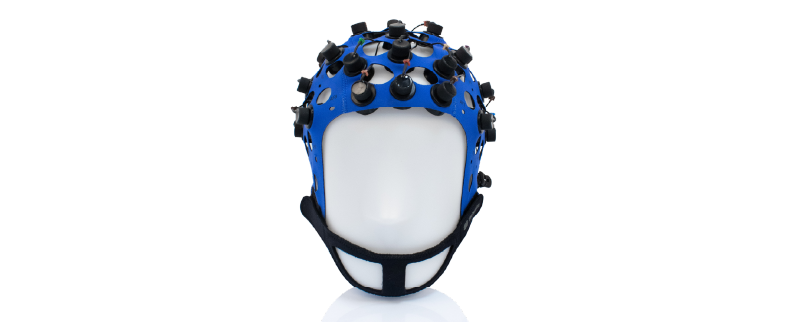
Bitbrain Versatile EEG 32
32-channel water-based EEG cap.
Product and image source · Bitbrain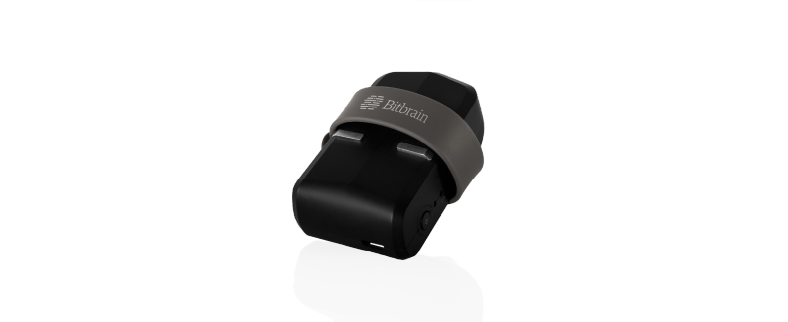
Bitbrain Ring GSR/BVP
Wearable sensor for skin conductance, blood volume pulse and motion.
Product and image source · BitbrainiMotions Multimodal Recording System
This system combines EEG, screen-based eye tracking and electrodermal activity recording. The software package includes iMotions Core, Screen-Based Eye Tracking, Affectiva, GSR and EEG modules.

Neuroelectrics Enobio 20
20-channel wireless EEG system.
Product and image source · iMotions
Smart Eye AI-X 60 Hz
Screen-based eye tracker.
Product and image source · iMotions
Shimmer3R GSR+ Kit
Wearable sensor for skin conductance measurements.
Product and image source · iMotionsSoftware
- Bitbrain SennsLab: The experiment software we use with our Bitbrain devices. In one environment we design the experiment, present the stimuli in sequence, and record physiological signals such as EEG and GSR time-locked to the stimuli.
- iMotions: A multimodal platform that collects data from different sensors on a single timeline. We can record EEG, eye tracking and skin conductance at the same time and analyse them together. Our package includes the Core, Screen-Based Eye Tracking, Affectiva facial expression analysis, GSR and EEG modules.
- Neuroelectrics NIC2: Device control, signal quality monitoring and EEG recording for the Enobio 20. Its Lab Streaming Layer (LSL) support lets us synchronise recordings with experiment interfaces we write ourselves.
- Python and web-based tools: We build our own experimental environments and task interfaces. For biosignal processing, data analysis and machine learning we rely mainly on open-source Python libraries.
Open-Source Python Libraries
The core libraries we recommend to anyone starting out in the field:
- NumPy: The foundation of numerical computing. Holds signals as multidimensional arrays and processes them fast.
- SciPy: Scientific computing tools such as filter design, the Fourier transform, spectral analysis and statistics.
- pandas: For organising and analysing tabular data, such as experiment logs and extracted features.
- Matplotlib: The basic plotting library for visualising signals, spectra and results.
- MNE-Python: The most comprehensive open-source toolkit for EEG and MEG data: reading data, preprocessing, artefact removal with ICA, epoching and topographic maps.
- NeuroKit2: Processing and feature extraction for physiological signals such as ECG, skin conductance (EDA/GSR) and respiration.
- scikit-learn: The classic machine learning library for classification, regression, cross-validation and model evaluation.
- XGBoost: A fast and widely used implementation of gradient-boosted decision trees.
- PyTorch: For building and training deep learning models.
- Lab Streaming Layer: For collecting data streams and event markers from different devices and software on a single timeline.
- PsychoPy: For building experiment and stimulus presentation interfaces with precise timing.
News
News from Izmir University of Economics about our lab and team.
Funding Calls And Research Announcements
Last checked: 6 November 2026
Open Calls
- TÜBİTAK 2209-A and 2209-B. Research and industry-oriented project support for associate and undergraduate students. Online applications close 11 November 2026 at 17:30; institutional e-signatures are due 23 November 2026. Official call
- İZKA 2026 Technical Support. Applications for the Green Transformation in Industry and İzmir Studies programmes close on KAYS on 30 December 2026. Eligibility and scope vary by programme. Official call and guides
- Horizon Europe 2027 Health Cluster. Published topics include AI-based predictive biomarkers and clinical trials for neurodegenerative diseases. HaDEA lists 17 February 2027 at 17:00 Brussels time as the first submission deadline. Check the schedule on the specific topic page before applying. HaDEA notice and topic links
IUE Announcements
- IUE Scientific Research Projects (BAP). Eligible IUE researchers submit their internal funding application form to the Project Development and Technology Transfer Office. IUE BAP and TTO information
- Faculty of Engineering FENG 497. The Fall 2026–2027 graduation project proposal deadline is 13 November 2026. IUE project calendar
Events And Second-Stage Submissions
- Horizon Europe Health Cluster. Online brokerage event on 24–25 November 2026 and Health Cluster Info Day on 26 November 2026. Event and registration information
- IHI Call 13. Full proposals are due 21 April 2027 at 17:00 Brussels time for consortia invited to stage two. Official IHI call
Programme And Application Resources
News From The Lab
Our website is live
The lab's Turkish and English website is now online.
The Computational Neuroscience Lab website is live. You can follow our research, team and publications here.
We joined the EEG101 COST Action
Our lab has been accepted into EEG101, a European COST Action network for open and rigorous EEG science.
Our lab has been accepted into the COST Action EEG101: Fundamentals of Open & Rigorous EEG Science (CA24148).
EEG101 is a European research network launched 101 years after the discovery of the EEG signal. It aims to standardise recording, analysis and reporting methods that vary from lab to lab, bring large datasets together and make EEG research more reproducible. To do so, the network develops shared tools and protocols, runs summer schools and supports short research visits between labs.
Joining the network is an important opportunity for us to collaborate with EEG labs across Europe and to align our work with international standards.
Our IUE BAP infrastructure project was accepted
The infrastructure project we prepared under Izmir University of Economics' Scientific Research Projects programme has been accepted.
The infrastructure project we prepared under Izmir University of Economics’ Scientific Research Projects (BAP) programme has been accepted.
The project will strengthen our lab’s experimental recording infrastructure and allow us to expand our multimodal biosignal studies. We thank Izmir University of Economics for its support.
Our TÜSEB-B proposal passed pre-evaluation
Our proposal to the 2026 TÜSEB-B call, built around an improved fNIRS device, passed the pre-evaluation stage. The detailed evaluation result will be announced on 18 December.
Our proposal to the 2026 group B call of the Health Institutes of Türkiye (TÜSEB) has passed the pre-evaluation stage.
In the project we are working on an improved fNIRS device. fNIRS (functional near-infrared spectroscopy) is a portable brain imaging method that measures changes in blood oxygenation in the brain using harmless near-infrared light sent through the scalp. Our goal is to improve recording quality and coverage with AI running on the device itself.
The detailed evaluation result will be announced on 18 December 2026. We’ll share it here.
Blog
Short posts, experiment notes and thoughts from the lab.
Listening To A Stadium From Outside, What Does EEG Measure?
Our brains hold around 86 billion neurons, and EEG can't hear any single one of them. So what are we actually recording?
Our brains hold around 86 billion neurons. Imagine standing outside a football stadium. There are tens of thousands of people inside. You can’t make out what any one person is saying. But when a goal goes in, or a whole stand starts chanting at once, you hear a clear roar even from the street.
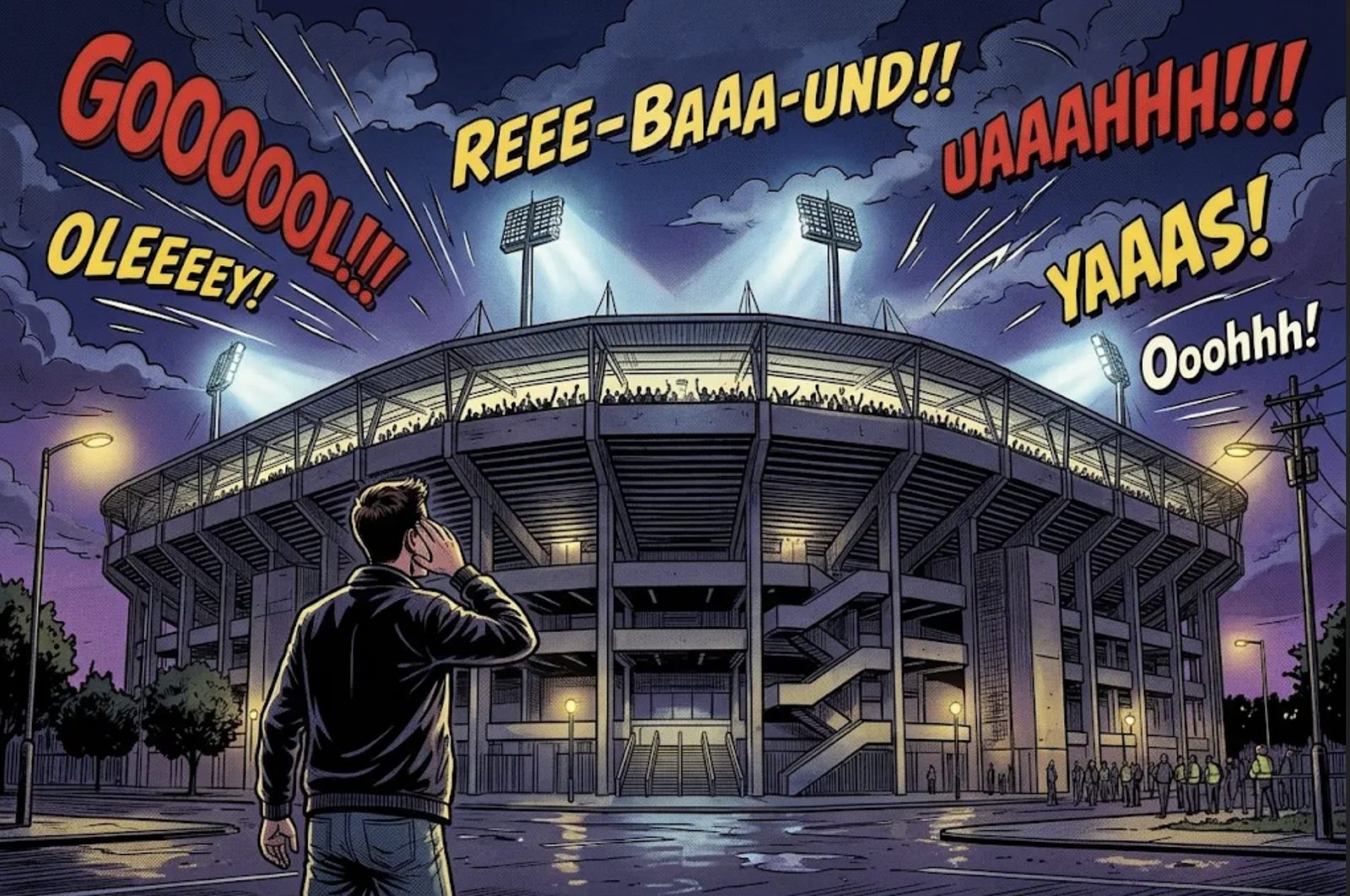
From outside we don't hear individual voices, only the combined roar of the crowd. EEG works exactly like that. Neurons in the brain talk to each other with tiny electrical signals. A single neuron’s signal is far too weak to measure from outside the skull. But when thousands of neurons fire together, in the same rhythm, the combined signal reaches the electrodes we place on the scalp. The waves we see in EEG are the brain’s “collective chants”.
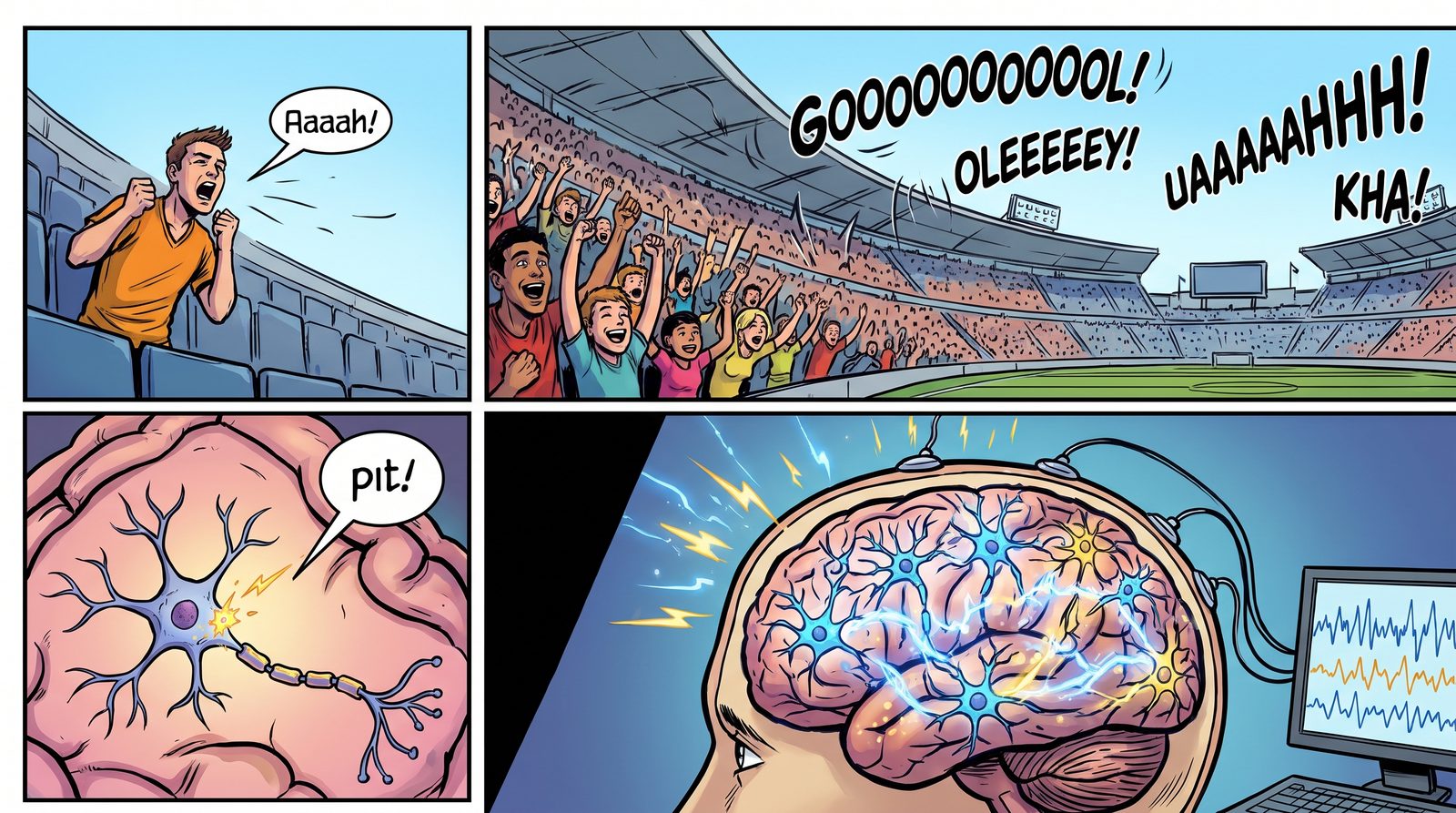
Like a single fan's voice, a single neuron's signal gets lost. When thousands work together, a signal strong enough to reach the electrodes emerges. Rhythms
This collective activity tends to oscillate at certain speeds. We call them frequency bands:
- Delta (0.5–4 Hz): the slow waves of deep sleep.
- Theta (4–8 Hz): drifting off, daydreaming, some memory processes.
- Alpha (8–13 Hz): grows when you close your eyes and relax. It’s the easiest rhythm to see.
- Beta (13–30 Hz): awake, focused, thinking.
- Gamma (30 Hz and above): linked to intense moments when information is being pulled together.
These aren’t “states” with sharp borders. The brain produces a mix of these rhythms all the time, and we look at which ones dominate and by how much.
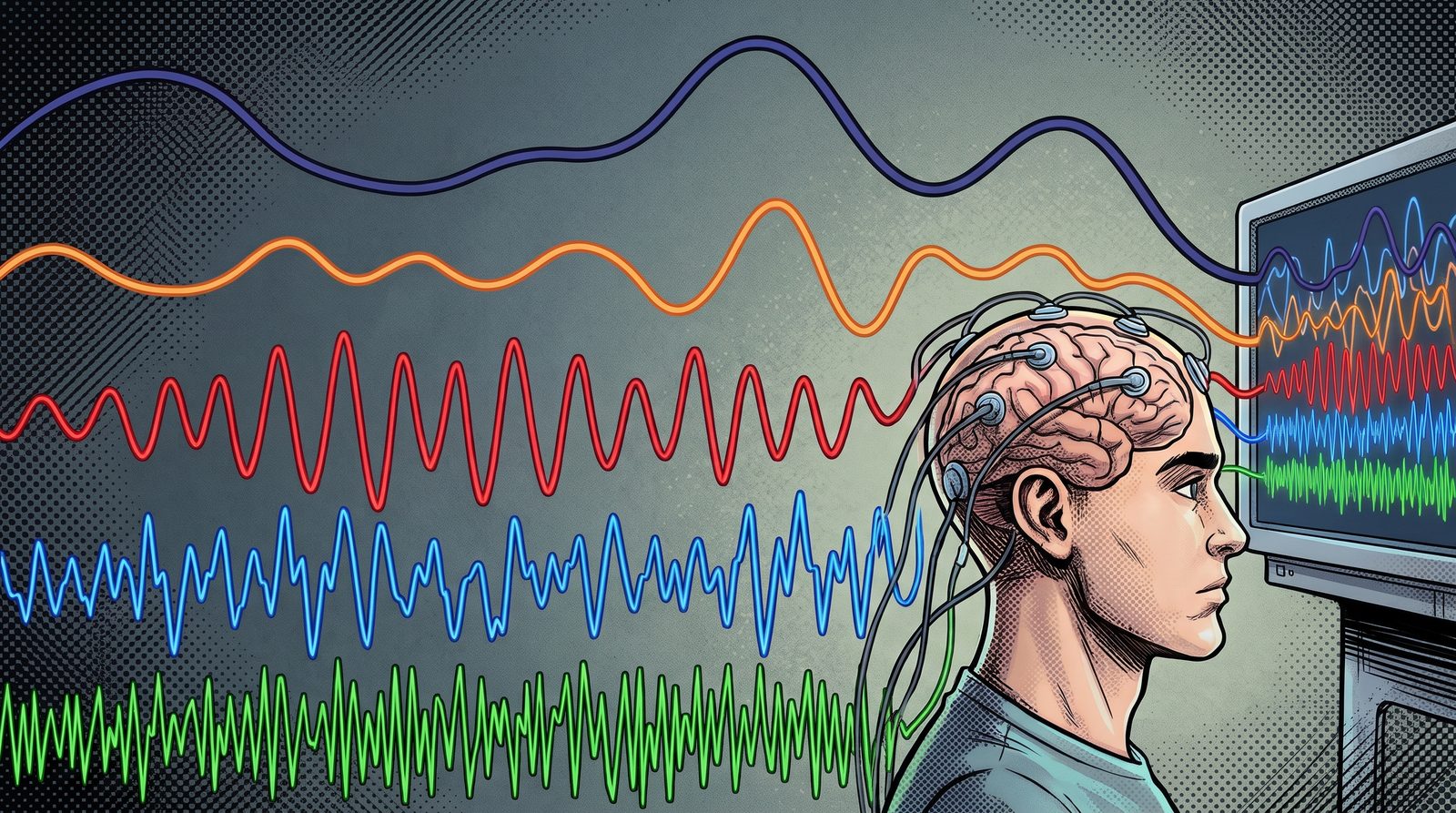
From top to bottom, slow to fast: the EEG signal is a mix of rhythms at different speeds. Strengths And Weaknesses
EEG’s biggest strength is speed. It captures the brain’s response to a stimulus at the millisecond scale. We can measure the gap between the moment you see a logo and the moment your brain reacts to it.
Its weakness is location. Back to the stadium: you can roughly tell which stand the roar comes from, but not which seat. Pinpointing what happens deep inside the brain takes other methods, such as fMRI.
Fast, portable, relatively cheap and completely harmless, EEG is ideal for studying everyday decisions.
References
- Azevedo, F. A. C. et al. (2009). Equal numbers of neuronal and nonneuronal cells make the human brain an isometrically scaled-up primate brain. Journal of Comparative Neurology, 513(5), 532–541. DOI: 10.1002/cne.21974
A Flashlight Against Your Finger, What Does fNIRS Measure?
Looking into the brain with light sounds like science fiction. Yet fNIRS rests on the same idea as the red glow of a flashlight pressed against your finger in the dark.
In a dark room, press a flashlight against your fingertip. Your finger glows red. Some of the light makes it through skin, bone and blood and comes out the other side. The pulse oximeter clipped onto patients’ fingers in hospitals relies on this simple observation: it measures oxygen in the blood by looking at the light that passes through.

Light passes through skin, bone and blood and comes out the other side. How Does fNIRS Do It?
fNIRS (functional near-infrared spectroscopy) applies the same idea to the head. We place small light sources on the scalp, with light detectors a few centimetres away. Light from the source scatters through the tissue, some of it reaches the surface of the brain, turns back and arrives at the detector. By looking at how much of the light was lost on the way, we learn what is happening in the blood of that region.
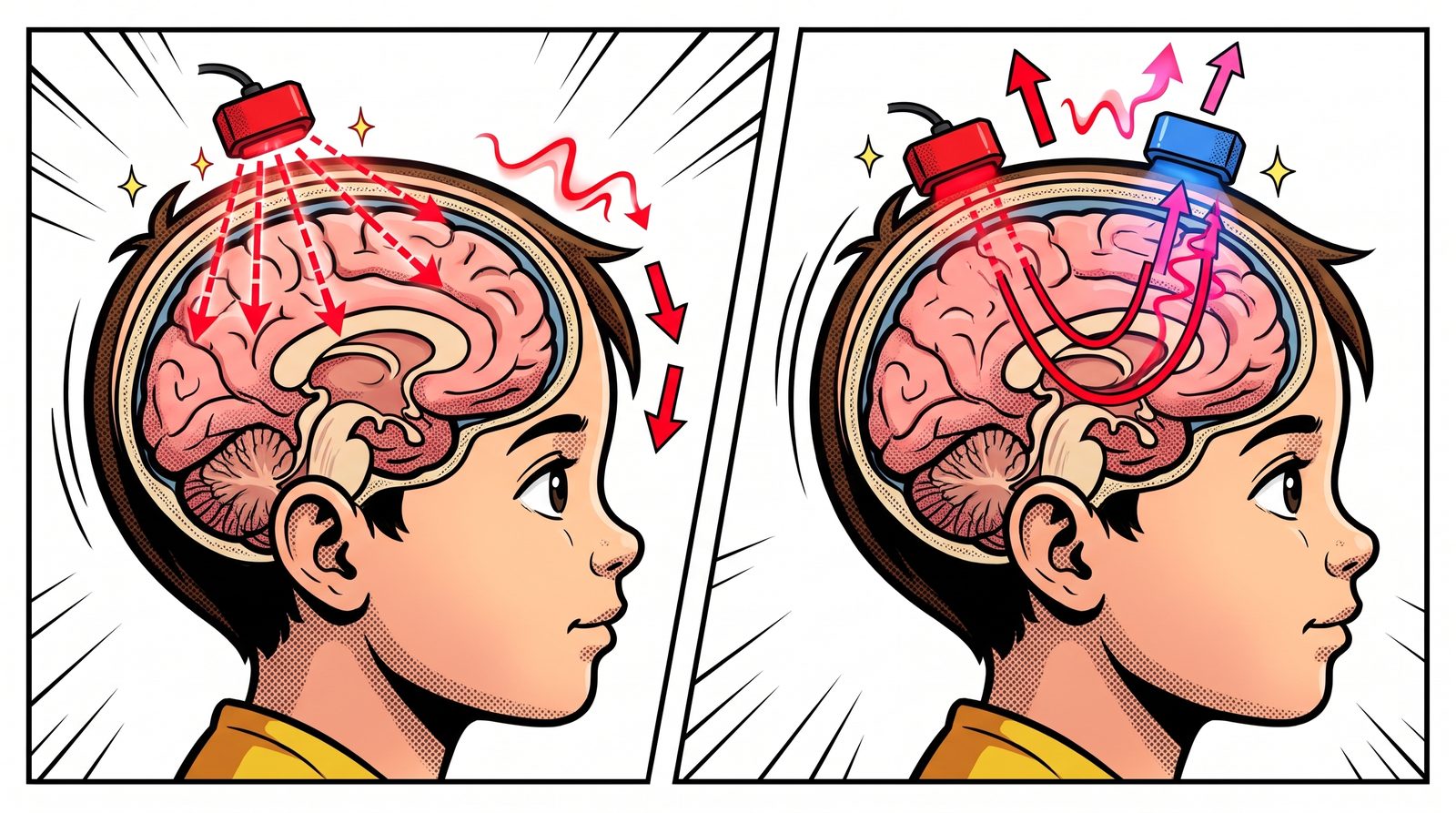
Left: light from the source scatters through the tissue. Right: part of it follows a curved path back to the detector (blue). Why Near-infrared?
Most visible light is absorbed as soon as it enters tissue. But for near-infrared light, roughly 700–1000 nanometres, biological tissue is surprisingly “transparent”. Frans Jöbsis noticed this “optical window” in 1977 and showed that light could cross the skull and reveal oxygen changes in the brain.
What makes this window useful is haemoglobin. Oxygen-carrying haemoglobin (HbO) and haemoglobin that has released its oxygen (HbR) absorb light differently at different wavelengths. By measuring at two wavelengths, we can work out the change in each of them separately.
A Working Region Asks For Blood
The brain has no real energy storage. When a region gets busy, fresh oxygenated blood is rushed there. This is called neurovascular coupling. Think of a city council adding extra buses to a neighbourhood at rush hour: when the crowd grows, the service grows too, often a bit more than needed.
As a result, oxygenated haemoglobin rises and deoxygenated haemoglobin falls in the active region. fNIRS picks up this opposite movement. So fNIRS doesn’t listen to neurons directly; it tracks the blood the neurons “ordered”.
A Banana-shaped Path
Light doesn’t travel from source to detector in a straight line. It scatters through the tissue along a curved, banana-shaped path. The farther apart the source and detector, the deeper the banana goes, but the less light comes back. In practice, a distance of about 3 centimetres in adults reaches the outer surface of the brain, the top few millimetres of the cortex. Deeper structures are out of fNIRS’s reach.
What Does The Output Look Like?
Each source–detector pair forms a channel. Labels like S1-D1 in the figure show which source is paired with which detector. Each channel gives us two curves over time: the change in oxygenated and in deoxygenated haemoglobin.
If we average these curves over a time window during the task and compare them with rest, we get a colour map over the head. Red areas are where oxygenated haemoglobin rose clearly during the task, the regions “ordering” more blood. Blue areas show no rise, or a drop.
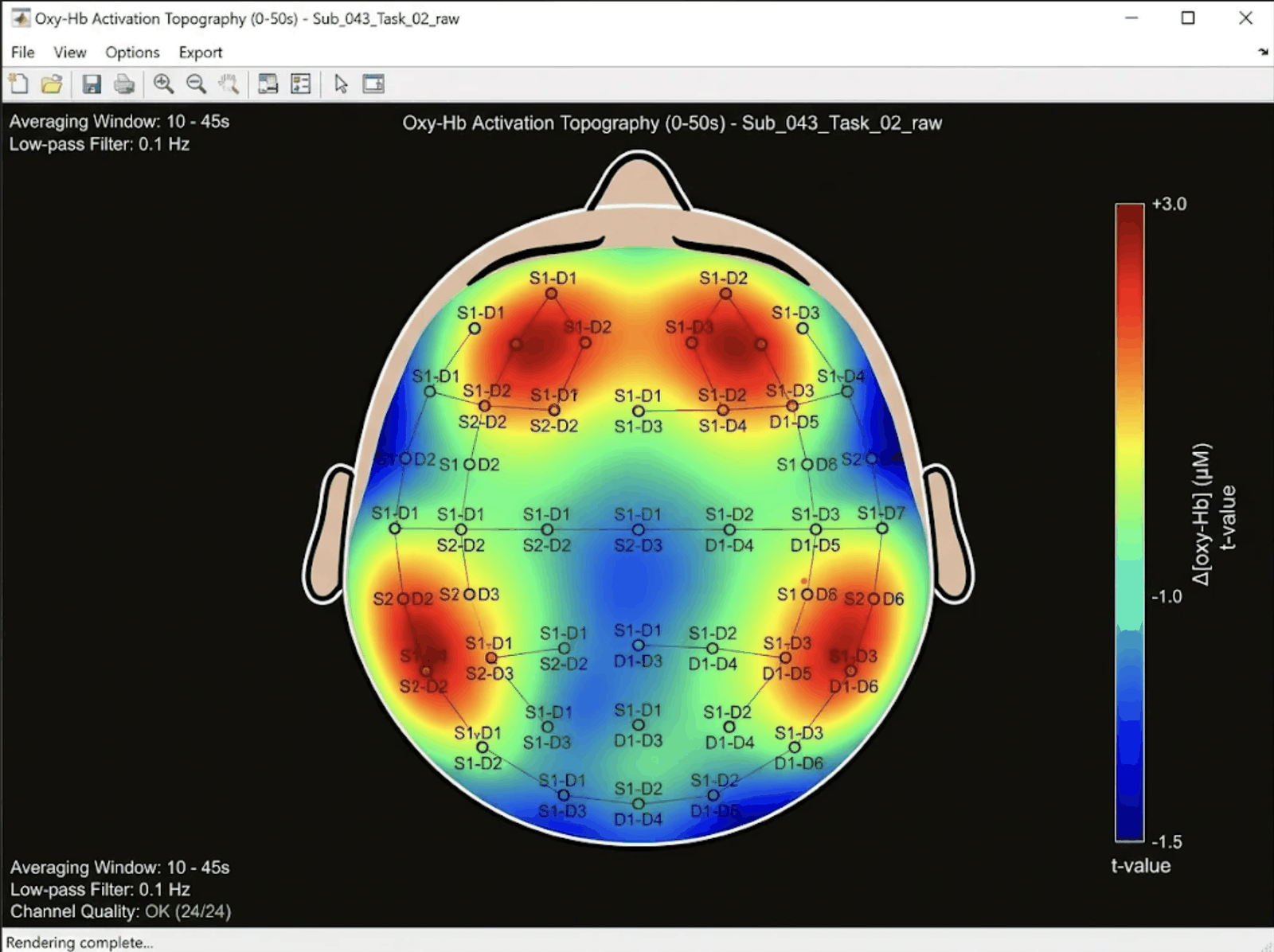
An illustrative fNIRS output: the distribution of oxygenated haemoglobin change over the head during a task. Compared With EEG
EEG listens to the roar from the stadium: it catches electrical activity within milliseconds but struggles to say exactly where the sound comes from. fNIRS watches the bus traffic heading to the stadium: changes in blood flow take a few seconds to show up, but which area is getting “crowded” is clearer.
That’s why the two are complementary, not rivals. Many studies use EEG and fNIRS together in the same cap: one answers “when” better, the other “where”.
Strengths And Weaknesses
Pros:
- Portable and silent. Nobody has to lie inside a tube; recordings can be made at a desk, while walking or while shopping.
- More tolerant of movement than fMRI, and much cheaper.
- Easy to use with babies and children.
Cons:
- It only sees the surface of the brain.
- Light passes through the scalp first, so blood flow in the skin leaks into the signal. Extra short-distance channels and signal processing are used to remove it.
- Dark, thick hair can block the light, and placing the optodes takes patience.
fNIRS In The Lab
The first functional fNIRS measurements in the human brain were made in 1992. Since then the field has moved from single-channel devices to wireless systems that cover the whole head. In our lab we are working on an improved whole-head fNIRS system that can run artificial intelligence on the device itself. For the latest on this work, see our TÜSEB news.
References
- Jöbsis, F. F. (1977). Noninvasive, infrared monitoring of cerebral and myocardial oxygen sufficiency and circulatory parameters. Science, 198(4323), 1264–1267. doi:10.1126/science.929199
- Ferrari, M., Quaresima, V. (2012). A brief review on the history of human functional near-infrared spectroscopy (fNIRS) development and fields of application. NeuroImage, 63(2), 921–935. doi:10.1016/j.neuroimage.2012.03.049
Our Blog Is Live
We will use short posts here to share what we do in the lab, the behind-the-scenes of our experiments and what we learn along the way.
Our publications describe the results of our work, but rarely the path that led there. This blog is where we want to share that path: how an experiment was designed, the problems we ran into while recording, and why an analysis method did or didn’t work.
Posts will be short and will come from different members of the team. If you’d like to ask a question or work with us, you can always get in touch.
Conferences
Conferences where lab members presented their work, newest first.
- 2026 Medical Technologies Congress (TIPTEKNO) 1 paper
- International Conference on Control, Decision and Information Technologies (CoDIT) 2 papers
- 2025 Medical Technologies Congress (TIPTEKNO) 4 papers
- International Conference on Control, Decision and Information Technologies (CoDIT) 1 paper
- Signal Processing and Communications Applications Conference (SIU) 1 paper
- 2024 Medical Technologies Congress (TIPTEKNO) 3 papers
Contact
Get in touch or visit the lab.
- Joint projects and collaborations
- Prof. Dr. Aydın Akan
akan.aydin@ieu.edu.tr - Website and general enquiries
- Berkay İlber Tunakan
berkay.tunakan@ieu.edu.tr - Address
- Izmir University of Economics
Sakarya Cad. No:156, 35330 Balçova / İzmir
Work With Us
We welcome MSc and PhD applicants who want to work on EEG, biosignal processing or machine learning. We are also keen to work with academics on joint projects and professional collaborations.
Get in touch